Monday, May 11, 2015

Noah Goes Up to Oxford, or, A Visit to Hogwarts

Noah going through the barrier at King's Cross

“Is that Hogwarts?”  That was Noah’s question repeatedly as we wandered the winding lanes amid the honey-colored stone walls, towers, gargoyles, and crenellations of Oxford.  “Yes,” we could say now and then, as for instance when we visited the Divinity School at the Bodleian Library, in which some scenes for the HP films were shot. 

The Divinity School, taken by Noah

To which answer Noah would swish and flick his wand, levitating us or turning us into—what was it?—water usually.  Then majesterially we would move on to the next site.  To my delight, more than once the progress stopped at one or another of the marvelous ancient, wood-paneled Oxford pubs.  (You’ll notice, by the way, that Noah has already been sorted, via the Pottermore web site, into Hufflepuff.)

As you can tell, in recent weeks Noah has become a Harry fan.  Dad, of course, couldn’t be prouder.  We watched the first three movies on the MV Explorer, usually in the late afternoon, the magical (ha) happy hour time, sprawled on the bed with drinks and packets of weird chips from around the world (roasted chicken, paprika, sweet pepper, steak, chutney, and something from South Africa called curry bunny)—all this right before I had to go off to my evening hour in the Writing Center (I tried not to drink too much).  The problem with introducing a five-year old to Harry Potter is that you can’t really get that far.  The fourth through last stories get scary, and Noah doesn’t do scary very well.  He peeks through his fingers and asks me to sit with him.

Also a Noah photo
Oxford is for me a magical place, most certainly.  I instantly fell in love with England when I visited in 1979, aged 16, with a troop of high school students.  I have lived in Oxford for about, oh, two-and-a-half months of my life, first in fall 1988 when my former wife and I had student work permits and endeavored to have an Anglophiliac adventure, and later when I had a small grant to look at old books in the Bodleian for my PhD dissertation.  The place is full of ghosts for me.  I showed Susan and Noah where I used to live, took them out to places that had once been familiar walks:

The Bodleian Library

Radcliffe Camera

Waving the wand in the Bodleian Quad

Christchurch College on a gorgeous day

(Scott’s takeaways: everything is about five times as expensive as it used to be; the place is polluted with KFCs and Starbuckses; the general complexion of the populace is far more international; but the essential eternal Englishness of the place remains very vital, in the English politeness and reserve, in the gorgeous (and gorgeously named) villages and in the history-drenched cities, in the fabulous pubs and food.)

We had a wonderful time—mostly.  Nothing really (not even the wonderful cask-pulled ale) could temper the reality that our adventure was ending and we were shortly to be heading home.  I was regularly a burden to myself and others, most certainly.  I am writing this, in fact, on a Virgin Atlantic 747 headed (I almost wrote “steaming,” but this is roaring or charging) homeward.  Our feelings are mixed and intense, or at least mine are.  I don’t do well with transitions (note earliest blog entries).  This is a tough one.  Work looms.  On Thursday Noah has his goodbye ceremony from the SSU Children’s School, where he has spent three-and-a-half marvelous years.  In the fall comes kindergarten.  We can’t wait to see our families and friends.  But we’re coming back changed.  Our ties to the routines of previous years are looser, and we have little interest in lacing ourselves back into them in the same constricted way.  We have become adventurers.  We’ve done without so much that seemed so important before, and we haven’t missed all that baggage.  Who will we be, by virtue of these changes, in the place we call home?  


We spent two-and-a-half days in or around Oxford in total, and also two full days in London.  There we taught Noah how to navigate the London underground.  On previous visits to London, my days have been full (too full) with museuming and monumenting.  On this visit, we didn’t set foot inside the Tower of London or Westminster Abbey.  There was, admittedly, a forty-five minute blast through the British Museum, which is as ridiculous as it sounds.  Mostly we walked.


On the grounds of the Tower of London

Noah’s favorite things were a great playground we found:


And a replica of Sir Francis Drake’s flagship, the Golden Hinde (a replica I had seen in the eighties when she sailed into Humboldt Bay).

Sir Noah Cameron Drake


We also hung around with our friends the Scotti-Everett family; Noah got some final time with his dear friend Jude.

Hello?  Hello?

Near the National Gallery


Shaun the Sheep

Last farewell to a good, good buddy

Back in Oxford, we rented a car and took a drive.  Almost flipping a coin, we wound up a half hour north of Oxford at Broughton Castle, a lovely old manor house with fourteenth-century bits, set amid gorgeous springtime countryside.


Wearing an English Civil-War-era helmet

Stunning English country

The very last thing we did before returning to our B&B to pack was attend evensong Eucharist at the Merton College chapel: thanks to the opportunity for a little quiet and meditation and to hear a magnificent choir sing Taverner, the best of all possible things to do to complete our journey.


—+—

Flash forward.  Now it’s a week later, and we’re home and settling in.  Today is my 52nd birthday; yesterday was Mother’s Day, and we got to go down and see my folks and Susan’s mom; today Noah is back at the Children’s school at SSU—almost as if nothing has happened.  Honestly, our Semester at Sea adventure is seeming right now like a dream.

This is not the last blog entry.  I have at least one more to do, on some highlights of our shipboard time.  Perhaps another covering some ports I haven't reported on.  But England was the last port.

But the voyage was real.  Every now and then I get a wave of grief and loss for our ship and for our dear friends.  We really have changed and grown by virtue of the adventure—Noah especially.  I think he crammed about two years’ worth of social development into four months.  He’s a real boy now.  Susan and I were noticing that the only vestige left of his infancy may well be his preferred sleeping posture: knees underneath, butt in the air.  More than a quarter of Noah’s life with us before college is over.  I can hardly believe it.

We loved our voyage and feel so incredibly lucky to have been able to embark upon it.  But here’s the final take-home: a sea voyage makes a great analogy for life, as I’ve written.  But the truth is that a sea voyage is not life.  After the voyage, the adventure continues.  There is no reason why the rest of life can’t be just as much an adventure—indeed it is a mistake to see it as anything other than an adventure.  That’s our biggest learning.  All of us are adventurers, voyagers, sojourners.  Nothing we see, even if we’ve seen it a hundred times, is unbeautiful, unexciting, even unexotic.  There is no call whatsoever to live with polluted eyes--eyes unable to see the spirits animating the world.  The mistake is in domesticating into our habits and into our comforts.  Everything in the world, including our backyards, is an exciting new land to explore.

Here is the final photograph I took in England and the final photograph I took on our Semester at Sea adventure.  We’ve just left the Merton Chapel following the evensong service.  Susan and Noah, and I with the camera, are making our way to dinner through the old streets of Oxford—and beyond that on to a new adventure, whatever it might be.

Wednesday, April 29, 2015

Insha'Allah

In Fes

To my shame, I kept thinking our awesome guide Rami was referring to a place: “Now we are going to see the famous gate to the Medina in Sha-la.”  Or perhaps (fitting the French heritage of Morocco) it was “in Charlat.”  No.  The phrase is Insha’ Allah, “God willing.”  Insha’ Allah, we will meet a bit of the real Morocco.  Insha’ Allah, we will have a break from this van ride soon.  Insha’ Allah, we’ll make it back to the ship before it sails away.  I’m writing this actually ON the van, three minutes from “ship time,” meaning three minutes before all voyagers are supposed to be back on the ship, and two hours and three minutes before the MV Explorer is set to sail.  We’re about 35 kilometers away, plus rush-hour traffic time, so we shouldn’t have too much difficulty.  Insha’Allah.

Morocco.  Wow.  On the doorstep of the West, we find the place that, in many ways, is most strange.  To us, I mean, of course—us westerners, Christianity-steeped, pledged to “liberal” values (liberally defined), used to the clean, straight lines of the Gothic arch and relative co-mingling of the sexes.  My ethnocentrism is showing.  On the bus with me are, yeah, several Americans but also Noah’s best buddies, Nurul and Bernarda, two lovely and loving young women from Indonesia and Angola, respectively.

Bernarda, Nurul ("Noodle"), and Noah amid the stunning spring flowers

At least two Muslims, Nurul among them, are with us (Peri from Turkey being the other).

Peri and Noah

So what does it mean to say that Morocco is strange?  The strange and the alien are theories of relativity.  And I take any invitation to confront my ethnocentricity as a gift.  

Truth is, I found myself intoxicated by Morocco.  I would come back here in a heartbeat.  Passing through the streets of Casablanca now, half the women are walking home in chadors and scarves, half in jeans and bare hair.  A handcart piled high with fava beans passes in front of the van.  Men wearing djelebas cruise by on mopeds (although most of the men—crowds of young ones walking together arm-in-arm—wear the official young-male-Arab uniform of jeans, athletic shoes, and futbol jersey).  Now and then a donkey cart trots past.  Here in Casablanca, things are relatively western.  Up in Fes and Chefchouan and Meknes, I felt bodily dropped into another age and time.  Fes was founded in the ninth century.  Deep in the Medina, the twisty-laned market, Noah saw a reasonable facsimile of the life lived back then.  Heavily laden donkeys pushed us aside, their owners shouting “attencion, attencion!”  Butchers shooed flies away from the bloody lamb and chicken on their counters.  Olives, raisins, sardines, gaudy-colored chadors, more olives, olive oil, nougats and honeyed sweets, mint, mint, mint, and olives, olives, olives.


I love olives, and I was in olive heaven.  In the stunning mountainous country of northern Morocco, between the cities, hillside villages hold a peasantry that’s vanishing in Europe, the boys or be-robed elders herding goats, sheep, and cattle by the roadside.  Off on the opposite hillside, there’s a berobed man riding a trail on (you guessed it) a donkey.  We got to tour a country where people still routinely own—and use—donkeys.  Man.

At a roadside souvenir stand

It was a wonderful trip, too much bus time notwithstanding.  For Noah it was especially great.  He had a great time with old buddies (Rachel and Robin) 

Noah and Rachel (Rachel having shaved her head when we crossed the equator)

Robin and Noah

and newer ones (Nurul, aka Noodle) and Bernarda, along with lots of others.  Like his parents, he was pretty amazed and a little overwhelmed by the medieval Medinas with their winding lanes (thank Allah we had a guide).  

In the Medina in Tetuan

We all especially loved the stunning “blue city” of Chefchauen (the name means “View of the Mountain” or rather something more like, “Look at that Mountain, Wouldja”).  The city is indeed set on a mountain side, and its winding lanes and alleys painted in blue reflect the town’s Jewish heritage.  (Although the Jews left in the 50s, as in much of the world, as Israel came to be.)  Our hotel was completely lovely.


Noah playing video games (a new habit) in our gorgeous Chefchauen hotel room

There are no old cities like Moroccan old cities.  The inner walled cities (the Medinas) are alive and kicking—mostly due to the living culture, which is thick, thick, thick all around you.  It’s profoundly impressive.  The aesthetic is magnificent, of course—all color and geometry.  Islam has a strong anti-idolatry doctrine, rejecting depiction of the human face or figure, so the art is mosaic, wood carving, and play with abstract design.  

Noah is becoming a photographer.  He grabs the camera and does some pretty awesome stuff.  All these are by Noah:

Our wonderful guide, Rami

Carving in the Madrasa in Fes

The Madrasa's bathing basin--you ritually cleanse before praying

Noah's portrait of Bernarda

Noah's portrait of Noodle

Noah's portrait of Susan

We visited the Roman ruins at Volubilis—one of the important western outposts of the Empire breadbasket.  


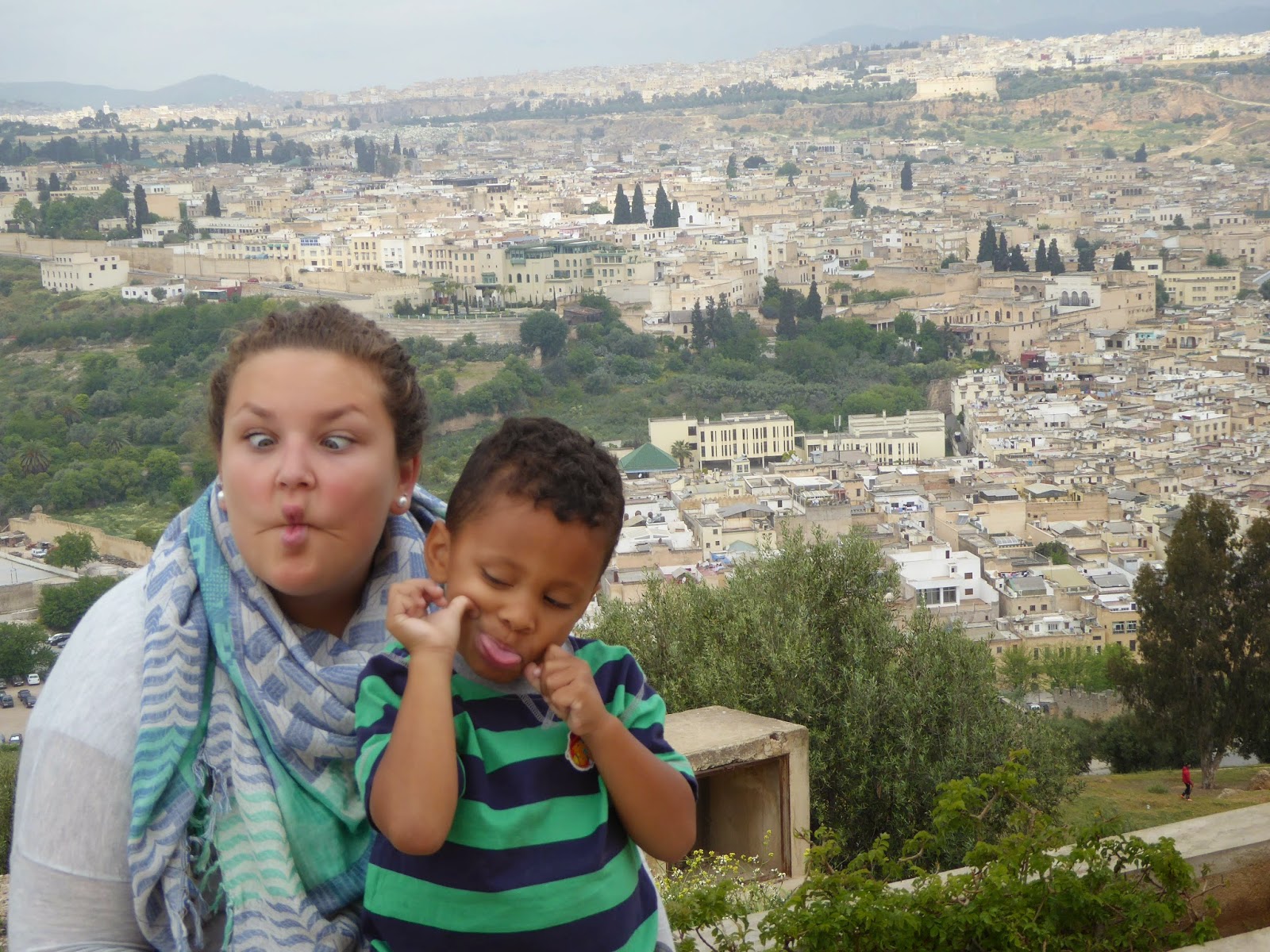
Always the ham

Love among the ruins

---  +  ---

Flash forward a week or so.  Since I wrote the last, we have completed our voyage.  (I’m writing this part from our B&B in Oxford.)  We made it.  As we rode at anchor in Portland Harbor, the most spectacular rainbow almost literally embraced the ship.  


What a ridiculous crazy blessing.  If you wrote a story with something like that for the ending, any respectable critic would have told you to cut out such improbable, sentimental claptrap.  Allah knows better than critics, I guess.  

I’m glad for the moment of the rainbow not only for us but for our beloved ship.  The MV Explorer is no more.  She has been sold, and her name will be changed.  She carried many voyages of Semester at Sea—and served as the space for many tearful goodbyes once the voyages were over.  Noah loved her with the pure love that children have.  On first boarding the ship back in January, Noah danced through her the way he had seen students do on a video we’d watched many times on the SAS web page.  Today as he was leaving he was held in a hundred embraces and returned every one heartily.  Everyone on the ship was made so much bigger and better by virtue of sailing on the MV Explorer—Noah perhaps more than anyone else.  

Well, may many more SAS trips bring such blessings to future students, faculty, staff, and crew.  Insha’Allah.


Tuesday, April 14, 2015

African Frontier

Outback Noah


We were not supposed to go to Namibia.  Originally our voyage was slated to visit Ghana and Senegal, two central African countries that were deemed to lie a little too close to the epicenter of ebola.  (At the time, it seemed to me that the Institute for Shipboard Education was being a little paranoid-careful, but now, having seen what students get up to in ports of call—fanning out into the hinterlands, hurling themselves off bridges and out of airplanes, jumping into shark-infested waters, etc. etc.—I have a keener understanding of the care that’s needed.)  Namibia was a good alternative, it seemed.  And so to Namibia Noah went.

You dock in Walvis Bay—pronounced “Valfish,” as in German Walfisch, i.e.,Whale-fish, i.e., whale (reflecting the region’s whaling history).  The nearest interesting town is Swakopmund, i.e., “Swakop-mouth,” the town at the mouth of the usually dry Swakop River.  The German history is clear in the language: this was one of their colonies, where South Africa, one country down, was Dutch and British.  It was also the site of the usual colonial exploitation, and more than usual, as the prototypes for WWII concentration camps were built here to quell Herrero uprisings.  As in South Africa, the painful ironies for a western traveler persist: poverty to the right of you, fanciful German architecture to the left.  We heard about and rued the brutal past; and we liked the beer and pastries, and I enjoyed practicing my rusty Deutsch.

But Namibia is so very different from South Africa—from any place we’ve been.  It’s the African frontier.  Even most of the indigenous inhabitants are relatively recent arrivals, all except the San: the small, lighter-skinned, smiling-eyed bush-people of southern Africa, still practicing elements of the oldest culture extant on the face of the earth.  The country is, like, twice the size of Texas and yet has only around two million inhabitants.  Huge expanses of the land—which mostly consists of desert dunes and scrub—are uninhabited.  Many folks live in villages or on family subsistence farms.  Where we went on safari in the north, the dominant currency is cows.  

Walvis Bay and Swakopmund are—what’s the polite way to put this?—sleepy.  On top of that, the four-day Easter holiday was shutting everything down.  Noah had some fun in Swakopmund—
Noah and Joseph at the Swakopmund Museum

We walked out the Swakopmund pier


Noah got grouchy because I was crossing the "kid bridge"

Whoo hoo for Namibia!

—but we were glad to head north 

Long open roads like Highway 50 in Nevada

to Etosha National Park, for a safari adventure.  


Before sailing, we had purchased three big adventure-type trips from Semester at Sea: our Guilin, China trip that I previously reported on; this current safari adventure; and a bus tour in Morocco (yet to be enjoyed).  I am conscious as the photographer that there may be no more torturous experience available to humanity than sitting through someone’s safari photos.  So here I’ll just show some of the best, with Noah’s adventures highlighted, and save a longer picture exposition for people willing to endure that on Facebook.

To Etosha we went.  I personally loved the experience of driving around (you can’t walk, otherwise lions will eat you, and I am not kidding) and keeping my eyes open for highlights.  Noah saw beautiful animals great and small.  Etosha is a large national park, at the center of which is a great dry salt lake or “pan.”  All the “Big 5” (lion, buffalo, elephant, rhino, leopard) are here, and all the rest of the beautiful and amazing animals unlucky enough not to be singled out as among the Big 5.  It was a feast of antelopes, first for the eyes and then, later, at dinner, for, yeah, the tummy.  That fact was a weird little vestige of the old meaning of safari as a game hunt.  We didn’t kill any antelope, but on the menu in the lodge for dinner were farmed versions of many of the animals we “shot” with cameras: kudu, springbok, oryx.  

Kudu

Oryx or gemsbok, named for the beautiful "gemlike" facial markings

Springbok.  They really do spring like bouncing balls

Noah mostly had a good time, but alas on this trip it was just him, his mom and dad, and some students and lifelong learners.  On our first day, we drove in a big bus around the park; on the second, we got in an open safari truck.

Zooom!

Here are some highlights.

Lions in the sunset

Impalas

Baby giraffe

Black rhino
Big bull elephant

Old man elephant

Zebra

Noah really liked watching out the conveyance windows.

Whoo hoo!  Finally an elephant!

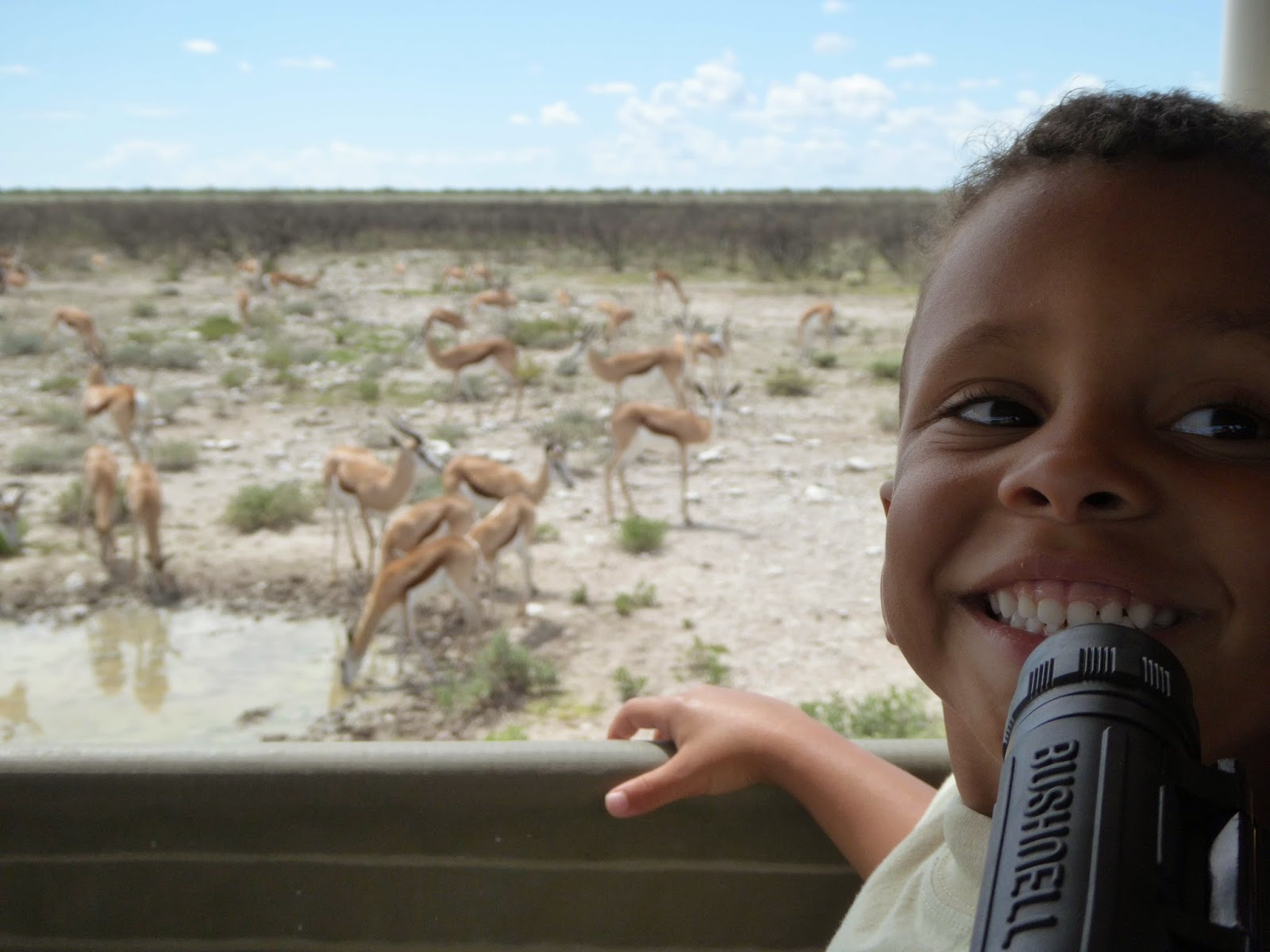
Springbok right outside the window!

Noah climbed an old signaling tower in the middle of the park:


And we greatly enjoyed the lodge where we stayed (Etosha Safari Lodge), which was sited on a hilltop overlooking the Etosha plain.  

Noah's beautiful birthday shirt

They had a great pool

Noah deliberately "behaving"

On the way home, we stopped at one of the big dunes and climbed up.  It was a highlight for Noah, especially because daddy carried him part of the way.  Sigh.

There she is!

Higher!

On top

The family in sand

Daddy pulled me all the way down

Namibia is an amazing place.  We recommend it wholeheartedly.  It's beautiful and interesting with amazing cultures and warm people.  

Noah is saying that he is ready to go home.  More and more, he's saying that he misses his house, his family, his friends.  One more country: Morocco.  Then a few days in the UK, then home.  We all are missing home, actually.  We hope to see all you faithful readers soon.