Saturday, February 21, 2015

Ubuntu

The night before we landed in Saigon (aka Ho Chi Minh City), Noah was co-awarded the ship’s Ubuntu stick.

“Ubuntu” is a term originating in southern Africa that roughly translates to being a mensch or cultivating compassion and community as you go; the basic idea is “I am human only because we all our human,” or, as Michael Onyebuchi Eze (see Wikipedia) puts it, “Humanity is a quality we owe to each other.”  Our wonderful Executive Dean, Bob Vieira, established the tradition of awarding an “Ubuntu stick” to deserving voyagers, voyagers who reflect the best values of ship-mateyness, community-building, caring for others, and simply doing the adventure right.

Here’s Noah with the Ubuntu stick.


Noah was awarded the stick with another fellow Guilin voyager, Robin, and we couldn’t be happier that Noah got to share this honor with this particular voyager.  Robin, if you remember, was the student who walked hand-in-hand with Noah all the way down the Moon Mountain trail.  We love Robin to pieces.


Ubuntu.  It’s often said of kids that they accept everyone regardless of skin color, age, body type, etc. etc.—that they lack the judgments that age and enculturation bestow upon us.  Well, it’s not that simple, as anyone who has broken up a fight between two-year olds knows (i.e., every parent).  But it’s largely true.  Kids aren’t naturally messed up.  So in a sense—in the sense that all kids kind of naturally embody Ubuntu, naturally and unquestioningly accepting and including others—Noah was a wonderful choice for the Ubuntu stick.  And of course, mommy and daddy were proud as peacocks once again of our amazing guy who cannot help making people fall in love with him wherever he goes.

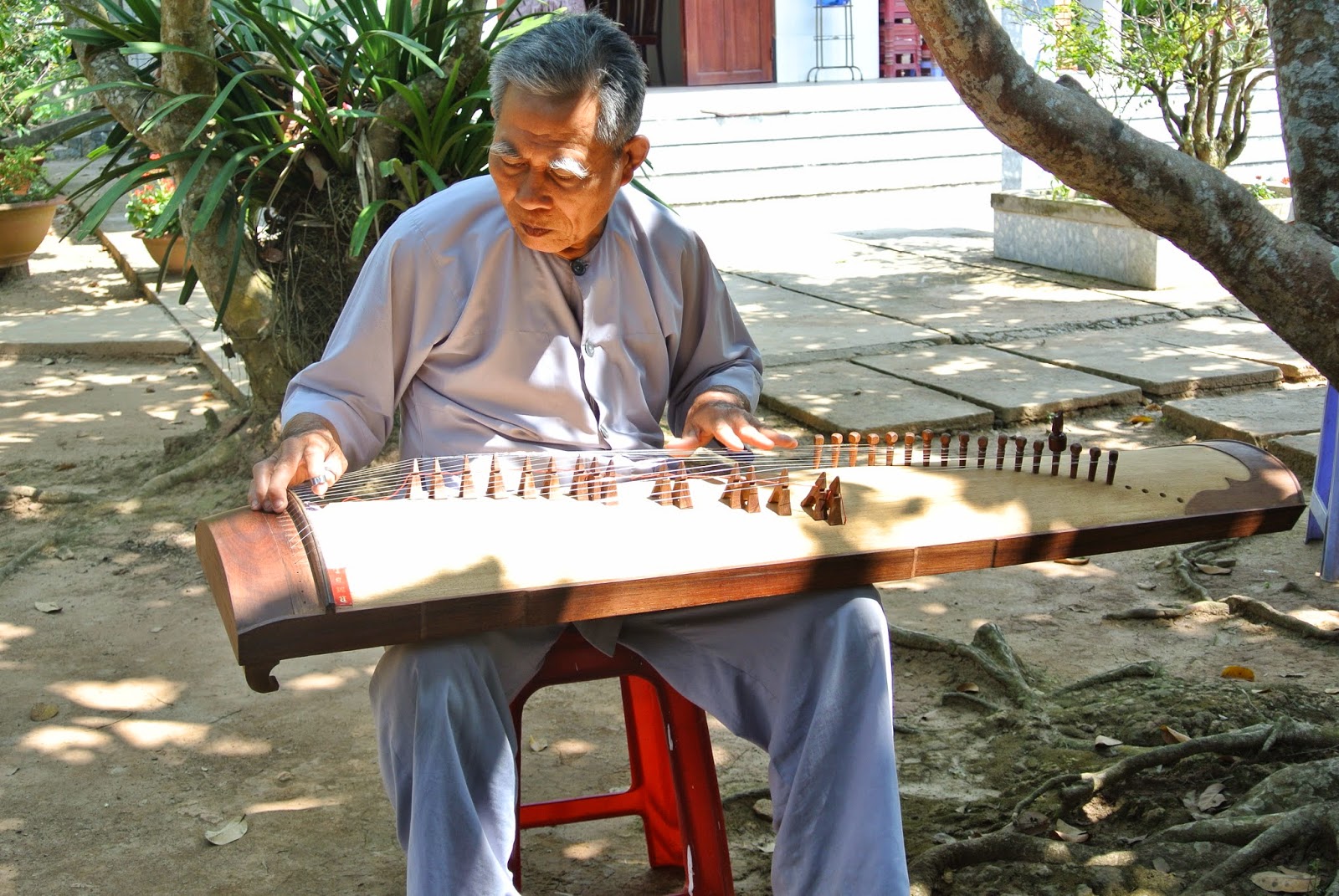
I think the very trip itself teaches Ubuntu values.  We’ve just had our taste of Vietnam.  It felt to me like the first place we had been to that was truly different.  Japan is very westernized (indeed, the Japanese take everything the rest of the world has to offer and makes it better).  China was full of smog and industry even as it clearly had its distinctive landscape and culture.  In Vietnam, we heard gorgeous indigenous music:

Amazing voices singing in pentatonic.


Ate beautiful local fruit:

Clockwise from right: pineapple, mango, dragon fruit, jack fruit, sweet little bananas.  In the middle, two kinds of salt.


Waded across streets packed with whizzing motorcycles, each carrying one, two, three, or four people (aside: who knew that a motorscooter could be family transportation?  Easy: dad’s driving, mom’s on the back, baby is squashed between them, legs and arms akimbo, and junior is standing on the foot board staring out across the handlebars):

Zoom.


Drank local tea with local honey and local bee pollen and local lime:


Nectar.


Communed with the local wildlife:

With dear friend Rachel.


Shopped in markets that were very different from markets back home, in terms of both the food products and the layout:

Ben Thanh Market


Those squid were very large.


And took a number of indigenous modes of transport:


Giddyup

With friend Jude

I loved Vietnam, jut ate it all up, literally and figuratively, and fell in love with its beautiful people and deep, deep history and culture.  Such friendly people.  In the seventies, my family helped settle Vietnamese refugees, and my memory of them is just of kind but quiet people.  Now I have seen them in their element, and what a smiling, lively, gifted people they are.  And loving: everywhere Noah was smiled at, cared for, enjoyed, teased, cajoled, seduced, and generally embraced.  For instance, one day we went to a private home to help make banh chung for shut-ins.  These savory rice-bean-pork cakes wrapped in leaves are a must for Vietnamese during Tet (New Year).  The lovely people at the house welcomed us all warmly, especially Noah, who resolutely remained shy but clearly loved the experience nonetheless.

Making Banh Chung.


I wonder if it’s not so much that children embrace Ubuntu but rather that children inspire adults to embrace Ubuntu.  Simply put, the world loves children.  As I wrote in an earlier entry, when I became a dad, I was first struck with the incredible quantity and quality of love it takes to raise a child.  Now I wonder, why am I so shocked and surprised?  Perhaps it’s only in an individualism-driven country that people are forced to labor under the apprehension that raising children is not the responsibility of the whole community.  America is a lonely outlier in its refusal to embrace mandatory child-care leave, socialized day care and preschool, and so forth.  Our country seems pathological to me in that regard.  My family is everyone’s family, and everyone’s family is my family.  


If my humanity depends upon my ability to see and acknowledge the humanity in others, the trip is teaching me that, world-over, the recognition begins with children.


Monday, February 9, 2015

It Takes a Village

“It takes a village” is one of those thoroughly overused phrases that’s also entirely true.  I expect most parents experience something like the same epiphany that I did upon become a daddy: something on the order of “good lord, the sheer amount of LOVE needed to raise one single child to healthy adulthood!  Have I got enough of that stuff?  God, I hope so.”

If you’re like me, you have way more of that stuff than you ever thought possible, but the truth is that, well, it isn’t enough.  An infinite amount, inside yourself, is not enough—not enough to overcome the limitations of your own mortal frailty, your own incapacity to be everywhere at once, your own small-heartedness, brokenness, and plain old fallibility.  

As I write this, it’s nearly 8 pm in Hong Kong.  We’re all getting ready to watch the city light show.  Noah is playing with a friend, seven-year-old Amari.  College students are lined up at the railing chattering and laughing, cameras armed and ready.  A young woman approaches her friends at the rail and gives several of them long, deep hugs.  A couple big guys are kicking a soccer ball back and forth.  One of them takes a half gainer into the deck and sits back up, laughing.  His buddy comes over and gives him a hand up.  Getting the ball going again, both of them assiduously avoid bonking any of the little ones on the head or running them over.  We’re just back from a four-day trip with three or so dozen of the best young people in the world—young people who made a village for Noah, one full of laughter and hugs and play and good conversation and patient caring and general delight in life—an insistence that life is to be delightful and people, especially children, are to be cherished and cared for.  It was so wonderful, profoundly moving and beautiful in every respect.  


Herewith some evidence.

Noah with his buddies Evan and Jared in Guilin.

With Evan.

With Jared.

Playing cards on a boat on the Li River with Myra and Patty or "Patty Rosemary" as Noah dubbed her.

The Limbo with Robin and Patty.

Climbing the Long-ji rice terraces with Jared.

In Long-ji with Evan.

Walking down (steep!) Moon Mountain trail with Robin.

Playing with buddy Matt.

Incongruously, there was a wax museum next to our hotel (which is on the right of the picture).  Here are Noah, Mr. Bean, and Jahlise.

With our beloved and wonderful guide Jenny.

It really was so wonderful, delightful, moving—the ongoing blessing of Noah’s enfoldment into this village.  I returned feeling more optimistic about the world than I have in years.  What an amazing group of young people.  I need to acknowledge the spectacular privilege on display here.  Some of these kids are scholarship kids, but most flatly have the means to embark on Semester at Sea.  I know from direct and vicarious experience that privilege can create what I sometimes think of as affluenza and other times as consumption: sickness of entitlement, a terrible shrinking of the world and spirit into a tiny, materialistic world of having.  But our experience in Guilin shows that privilege can be used well, to broaden and expand the spirit.  The MV Explorer is full of privileged kids of the latter quality.  My hope comes from the fact that, for good and ill, these are the kids who will grow to inhabit the halls of power.  Sadly, that’s the way the world works.  Thank God, some of the people with power will be these kids.


Oh, and I can’t tell you how grateful my shoulders are for the shoulders of those good, good strong guys.

Friday, January 30, 2015

A Worshipful Day

Our Neighbor Totoro

(Caveat emptor:  This blog is obviously more appropriately entitled “Scott Observes Noah Sailing around the World,” Noah being only at the doorstep of literacy and all, so now and again, perforce, there might be an entry that’s really just in the category of “Scott’s Blog.”  Here’s one of those.  It’ll be long and a little academic, because I’m tracking down professional answers here as I write.)

Shrines and temples.  What are they, as spaces both physical and spiritual?  Whatever else, I think they are spaces or places where the boundary between the worlds becomes thin, where we can step for a moment almost inside that other place.  You know that other place: the place where the gods live, the place our ideas dwell—our ideas of what?  Of what moves our lives and bends their courses, and of the agents that do the bending: the spirits, the kami that animate the world.

At Jindai-ji Temple

Kami is a word in the Shinto tradition, which is Japan’s indigenous “religion” (words for these things are so inadequate).  I’ve learned more about Shinto in a week than I had the whole rest of my life, not because of being in Japan but because of this class I’m teaching aboard the MV Explorer.  It’s a composition class with a theme called “Mythical Encounters.”  We’re talking about how myths translate across cultures, and by “myths” I don’t just mean Greek or Hindu myths.  We started with Harry Potter and Twilight, looking at how and whether those western products matter or translate abroad, then shifted to the wonderful anime films of Hayao Miyazaki and his Studio Ghibli.  As a class, we watched his beautiful film Spirited Away, about a ten-year old girl who unwittingly gets translated to the world of the kami.

Spirited Away

Shinto is a beautiful spiritual path.  In Shinto, the whole world is animated—infused with spirits (animae).  In Spirited Away, we meet spirits of radishes and rivers, frogs and chickens, and they all come to Madam Yubaba’s bath house to be washed and spa-ed, presumably to then return to the “real” world purified.  Purification is (apparently) an important theme in Shinto.  I gather (my knowledge being so paltry) that in this tradition “impurity” is not meant in the spirit of “sinful” or “defiled,” a la the shame-and-guilt-based ideas in Christianity, but simply “clouded”—your windows are dirty.  I really know what that means at present.  As in my earlier posts about my traveler’s anxiety, it’s not been an easy stretch.  A therapist I worked with recently said that, after fifty, “it’s all management,” meaning your time is short and the responsibilities are great, and the art of it is the art of balancing and scheduling, hoping that there will be a little time left over for your own heart and health.  

I have not been very good at the balancing act lately.  I love my job, and I love being daddy, but there is just so much to do and so little time, and I “manage” my days by finishing one task and shifting to another, then another, then another.  I grab an hour a week to do yoga, another to get to church.  In good weeks I manage to get a little painting done.  I know, I know, first-world problems, blahdy-blah.  I am profoundly privileged.  But still, willy nilly, I live in quiet desperation much of the time: very, very “polluted” with management concerns.  I go days without remembering to look at the sky or see what the birds are doing.  When you’re clouded, when your eyes are dirty, the world is dead around you.  When you’re clean, when your eyesight is clear, you see that everything around you is sacred and alive. 


We left the ship to find some clarity and unpollute our eyes.  “We” in this case were not Susan and Noah and I but rather my students and I, plus our wonderful guide Keiichi-san (family members are not allowed on “Field Labs,” the in-port component that every class taught in SAS is required to have).  I would say that our eyes were pretty clear from spending a couple of weeks washing them metaphorically in the waters of the blue Pacific. Still, we headed out, through Yokohama streets, on subways and trains and by foot, to two different kinds of shrines: the Jindai-ji Buddhist temple and the Museum of the Art of Studio Ghibli.


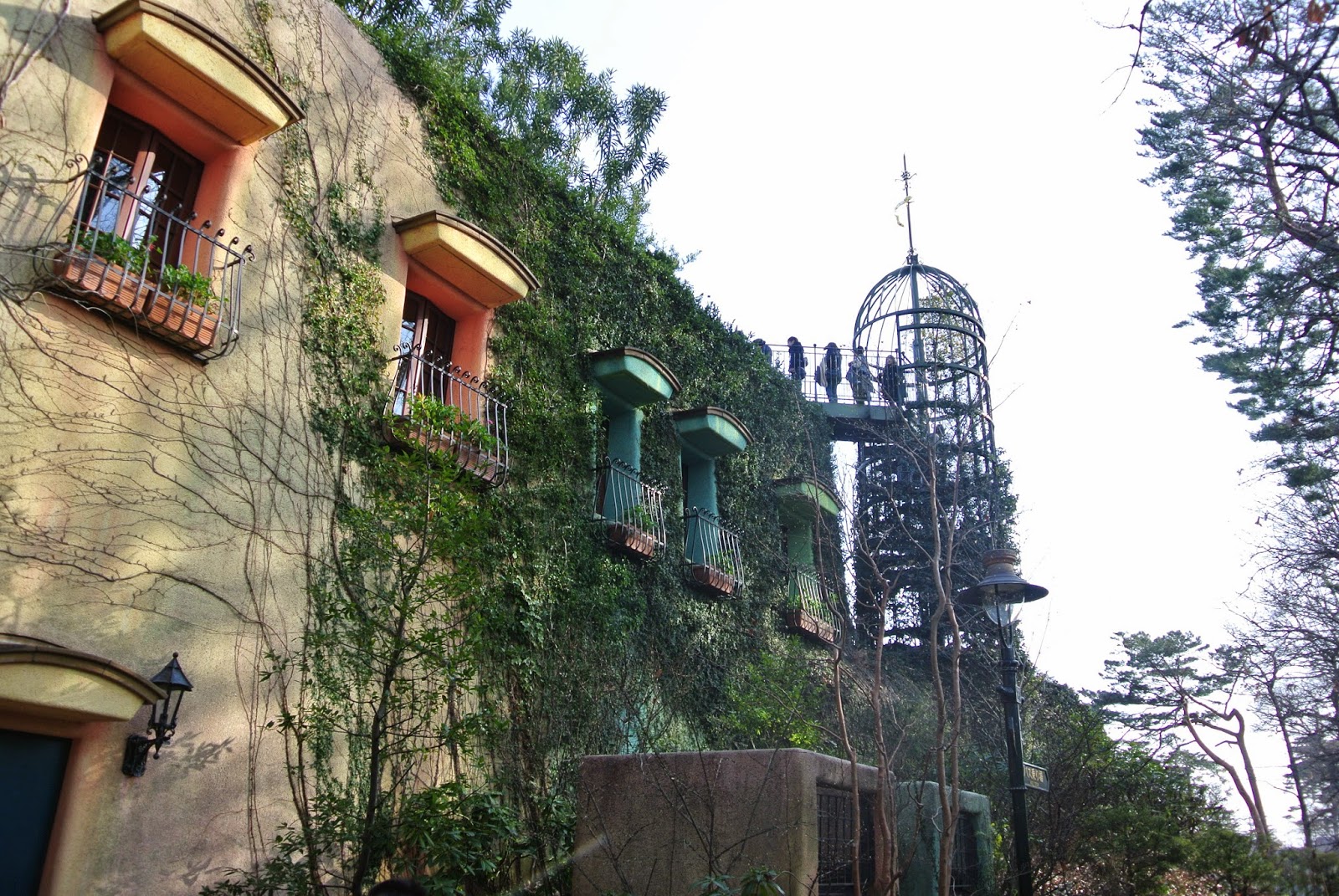
The Ghibli Museum was first.  It’s in a beautiful parklandish suburb of Tokyo called Mitaka.  It’s winter here in Japan, of course: chill air, bare trees, muted browns and grays.  The museum building is straight out of Barcelonean modernisme and, with its rounded edges and rococo accents, could have easily been designed by Gaudi.  I had invited my students to think of the museum as a sort of shrine.  Miyazaki’s films (Spirited Away, Princess Mononoke, My Neighbor Totoro, Kiki’s Delivery Service, Ponyo, and several others) certainly attract idolators and inspire adoration.  Miyazaki’s fans meet, they look into each other’s eyes, and they see, “oh yeah, you get it too—the Miyazaki thing.”  Some of this special quality has to do with the art of his films, which is flatly gorgeous, but I think more of it concerns the spirit with which his films are made.  These animated films are animistic films, spiritual in the sense both that they are infused with the spirit of a tradition (Shinto) that affirms the beauty and sacredness of the created world and that they have a great deal of worshipful integrity.  Their characters are treated with tremendous compassion.  There may be heroes, but there are no villains in Miyazaki’s films, only people who are managing, or failing to manage, despite or because of responsibilities or despite or because of the pollution in their eyes.  And in many films there are kami.  Totoro is Miyazaki’s iconic spirit of the woodland, the “neighbor” (no more tame than Aslan) who is there to hold and enfold, for instance, two little girls worried about their sick mother.   


The Ghibli Museum is a shrine.  You walk in (sorry, but no interior photography was allowed) down a long nave into a dim sanctuary with soft music playing.  There are exhibits like the saint-shrines in a Catholic church, little chapels or apses where you ooh and aah over tableaux from the films.  You rise through the dim interior on whimsical circular staircases, pass the gift shop / indulgence merchant, and emerge on the roof, which is landscaped and guarded by a giant robot soldier.  


If you manage to skirt the robot, you walk a narrow path and emerge into a grotto with an altar.  All of it is beautiful.  The best part for me was the reproduction of Miyazaki’s studio, with library, workbenches, painting space, models of scenes or machinery from the films, and, best of all, painting after painting of scenes and scenery from the films.  It was all just so wonderful.


From the Ghibli museum, we took a bus to the Jindai-ji Temple, arriving around 4.  The temple is beautiful and, of course serene.  You’re greeted at the gate by a guardian demon (sorry for the poor pic):


The poet David Whyte says that these monsters are there not to keep out bad elements but rather to invite you to invite in your deepest fears or to help you own your inner monsters.  Passing the guardian, you walk up a lane into the temple precinct and send your wishes and prayers into the Great Unknown via tossed coins and bowed prayers.


Purification is important.  You wash each hand, rinse out your mouth, and then rinse the cup.


Here you write your prayers and tie them to the lines encircling the sacred Buddha.


We didn’t get to step into the actual main temple building because it had just been shut by the monks.  Prayer bells gonged from within.


We strolled through the gardens and made our prayers and then walked in the direction of delicious soba and tempura for dinner.


Buddhism and Shinto exist side by side and completely companionably in Japan and have done so for centuries.  The secret, I think, is moving away from a conception of God as a personage—especially as a jealous, possessive personage.  What if “gods” are just the spirits, the life, animating a place?  What if god “is” animation?  And I have to wonder if Miyazaki-san himself has pondered the intersections of animism / animation?  Is Totoro really a kind of kami?  Is he / she (only now am I struck with the realization that Totoro is very much of ambiguous gender) worshipped, or will he / she be worshipped in the future?  Are the Totoro plushies available in shops all over Japan the same thing as idols we buy in cathedrals to lodge in niches in our homes?  And can we ask the same questions about Mickey Mouse figures in the west?


Whatever the answers to these currently unanswerable questions, I definitely felt my eyes washed clean on Monday, and I think my students did too.  

Noah understands Totoro better than I ever will, I think, but we all think he’s pretty great.

At the Studio Ghibli Store in Kyoto.

Thursday, January 29, 2015

First Views of Noah in Japan

Japan has been very wonderful for Noah.  But he's had a leeettle bit of trouble with his legs, poor man.  They keep failing on him.  Here he is unable to walk while crossing the Sumida River:


And here his legs have failed him in the Sumida District:


Then there was total leg failure 350 meters up the Tokyo Skytree:


Here Noah's legs COMPLETELY gave out on the grounds of the Senso-ji Temple:


Finally there was spectacular and catastrophic leg failure at the Asakusa Subway stop:


(By this point the game was clearly starting to be fun, so daddy called a halt.  A less ironic post shall come soon.)